

Austin, August 22, 2025
News Summary
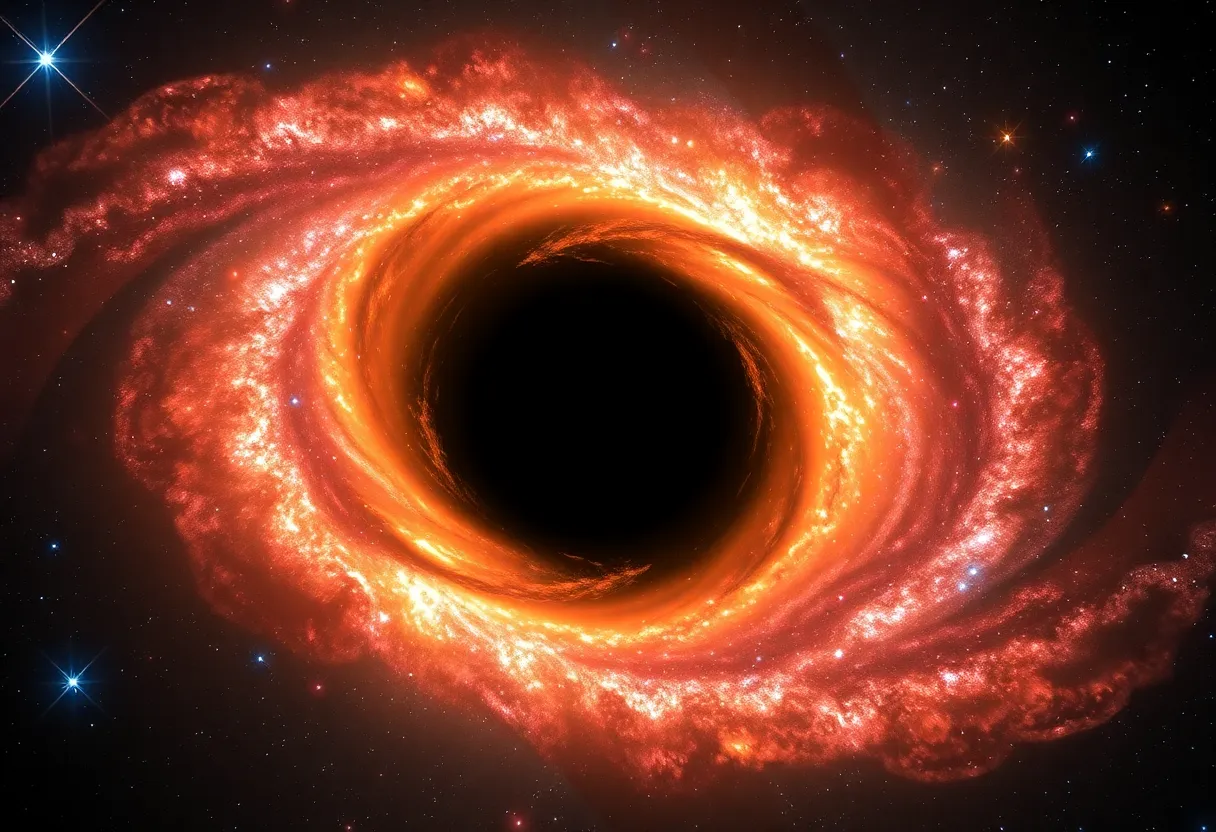
Researchers at the University of Texas at Austin have confirmed the discovery of the most distant black hole known, located in the galaxy CAPERS-LRD-z9. This black hole dates back 13.3 billion years, existing just 500 million years after the Big Bang. The team used the James Webb Space Telescope to analyze light from the galaxy, marking a substantial breakthrough in understanding the evolution of galaxies and black holes in the early universe. This finding reshapes our comprehension of cosmic development and the role of supermassive black holes.
Exciting Discovery in Austin: A Black Hole from the Dawn of Time
Welcome to Austin, folks! Buckle up for an out-of-this-world revelation that has astronomers buzzing with excitement. Researchers at the University of Texas at Austin have just confirmed the most distant black hole ever discovered! That’s right, they’ve peeked into the far reaches of the universe and found a fascinating cosmic entity nestled in a galaxy known as CAPERS-LRD-z9.
Journey Back in Time
Imagine this: CAPERS-LRD-z9 existed a mere 500 million years after the Big Bang, which itself happened about 13.8 billion years ago. This makes our newfound black hole sit snugly at around 13.3 billion years in the past! At that point, the universe was just a teeny tiny 3% of its current age. How cool is that?
A Leap Forward in Cosmic Research
The research team, hailing from the esteemed Cosmic Frontier Center at UT Austin, published their groundbreaking findings on August 6 in the prestigious Astrophysical Journal Letters. Leading the helm of this stellar exploration was postdoctoral researcher Anthony Taylor. The discovery showcases how astronomers are constantly pushing the boundaries of technology and knowledge.
The Marvelous Tool Behind the Discovery
So, how did they pull off this discovery? It all comes down to the incredible data provided by the James Webb Space Telescope. This advanced instrument utilized spectroscopy to examine light in various wavelengths, allowing astronomers to detect the signature of fast-moving gas swirling around the black hole. They observed both redshift and blueshift in the light emitted from this distant galaxy – a significant clue that hinted at the black hole’s presence.
The Little Red Dots
CAPERS-LRD-z9 belongs to an exciting new class of galaxies called “Little Red Dots.” These compact, bright red galaxies suggest that something intriguing is happening in the early universe, with their brightness appearing remarkably higher than anything previously captured. It turns out, the black hole’s mass—estimated to be around 300 million times that of our Sun—comprises about half the total mass of all stars in its host galaxy! That’s quite a hefty chunk!
Understanding Black Holes’ Quick Evolution
This finding implies that black holes in the early universe might not only have developed significantly faster than expected but also could have started with a greater mass than current models predict. This revelation adds another piece to the cosmic puzzle regarding how galaxies formed and grew.
A Bright Future for Black Hole Research
With black holes playing a central role in explaining the unexpected brightness of these “Little Red Dots,” it highlights a need to rethink our understanding of galaxy luminosity. Rather than merely looking at the number of stars contributing to brightness, we have to consider the impact of supermassive black holes driving that illumination.
As we learn more about the universe’s infancy, this discovery marks an important milestone for astronomers nationwide, offering fascinating opportunities to investigate how black holes and galaxies evolve over time. Keep your eyes on the sky, because we’re bound to see more cosmic revelations in the near future!
FAQs
What is the significance of discovering the most distant black hole?
The discovery provides insights into the early universe’s structure and the evolution of galaxies and black holes shortly after the Big Bang.
How was the black hole discovered?
Astronomers utilized data from the James Webb Space Telescope, specifically through spectroscopy, analyzing light to detect the black hole’s signature.
What makes Little Red Dots distinct?
Little Red Dots are compact, red galaxies that are unexpectedly bright and existed within the universe’s first 1.5 billion years, where their intrinsic luminosity is influenced heavily by the presence of supermassive black holes.
How massive is this black hole?
The black hole’s mass is estimated to be around 300 million times that of our Sun, constituting a significant portion of its host galaxy’s total stellar mass.
Deeper Dive: News & Info About This Topic
HERE Resources
Family Fun Awaits in San Antonio This Weekend
Additional Resources
- News4SanAntonio
- Statesman
- Houston Chronicle
- KXAN
- Fox 7 Austin
- Wikipedia: Black Hole
- Encyclopedia Britannica: Black Hole
- Google Search: Black Holes
- Google Scholar: Black Holes
- Google News: Black Holes

Author: STAFF HERE SAN ANTONIO WRITER
The SAN ANTONIO STAFF WRITER represents the experienced team at HERESanAntonio.com, your go-to source for actionable local news and information in San Antonio, Bexar County, and beyond. Specializing in "news you can use," we cover essential topics like product reviews for personal and business needs, local business directories, politics, real estate trends, neighborhood insights, and state news affecting the area—with deep expertise drawn from years of dedicated reporting and strong community input, including local press releases and business updates. We deliver top reporting on high-value events such as Fiesta San Antonio, San Antonio Stock Show & Rodeo, and Dia de los Muertos. Our coverage extends to key organizations like the Greater San Antonio Chamber of Commerce and United Way of San Antonio and Bexar County, plus leading businesses in retail, insurance, and energy that power the local economy such as H-E-B, USAA, and Valero Energy. As part of the broader HERE network, including HEREAustinTX.com, HERECollegeStation.com, HEREDallas.com, and HEREHouston.com, we provide comprehensive, credible insights into Texas's dynamic landscape.