

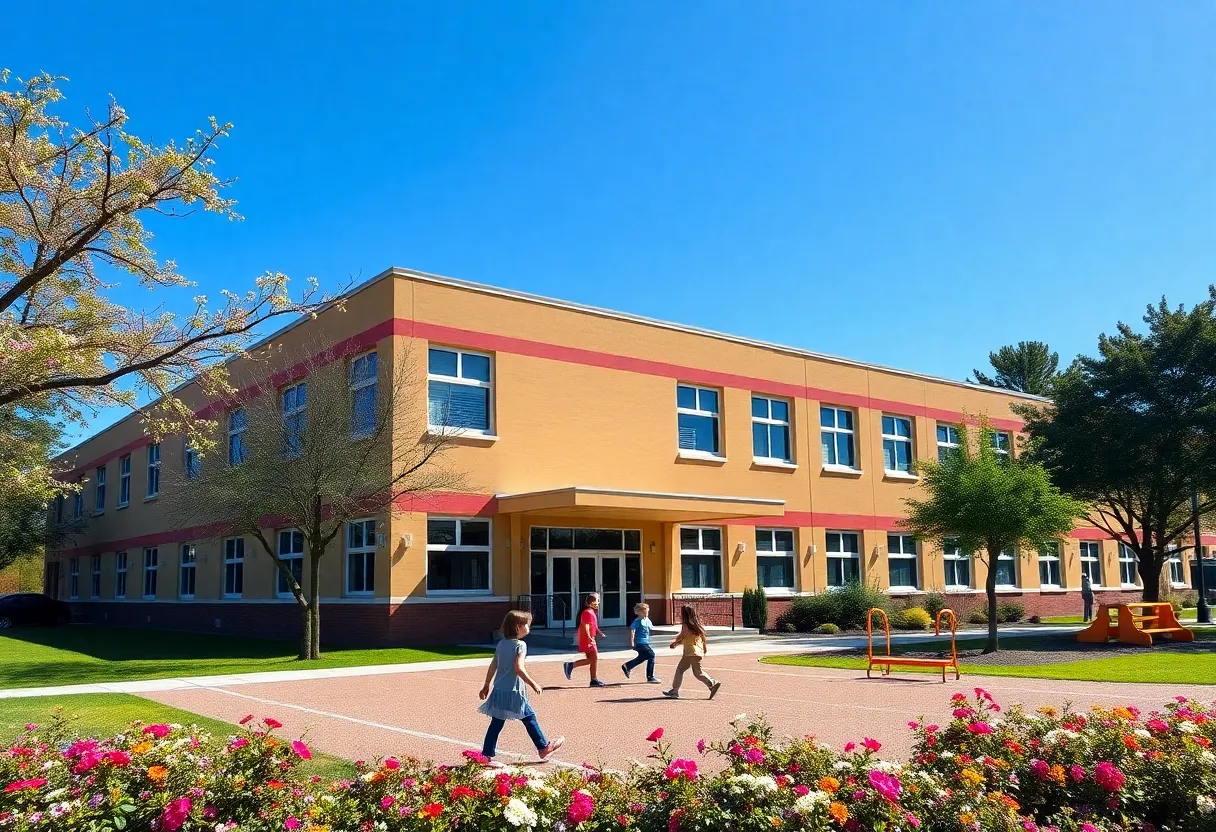
San Antonio, TX, August 16, 2025
News Summary
Harmony Hills Elementary, a part of the North East Independent School District, has advanced from a C to an A rating according to the Texas Education Agency. This leap places the school in an elite group of 95 campuses statewide that made significant rating improvements. Texas Education Commissioner Mike Morath commended the school’s staff for their dedication to enhancing student outcomes and bridging achievement gaps. Despite ongoing academic challenges in Texas, Harmony Hills serves as a beacon of success in public education.
San Antonio, Texas – Harmony Hills Elementary, part of the North East Independent School District (ISD), has made a significant leap in the Texas Education Agency’s (TEA) accountability ratings, moving from a C in 2024 to an impressive A in 2025. This remarkable improvement places Harmony Hills among only 95 campuses statewide that achieved such a substantial rating upgrade.
Texas Education Commissioner Mike Morath visited the school to acknowledge this achievement and emphasized the importance of public accountability in enhancing student outcomes. The A-F rating system is designed to give parents and the public clearer insight into school performance by evaluating a range of indicators beyond just standardized test scores. Morath remarked that schools achieving higher rankings often see improvements in overall student performance, including better graduation rates and higher rates of college enrollment.
The TEA’s grading system aims to assist educators in identifying areas needing improvement while also recognizing successes among campuses. Morath credited the educators at Harmony Hills for their dedication to closing achievement gaps and providing high-quality instruction, which played a pivotal role in the school’s rating improvement. Principal Carrie Elliott expressed pride in her staff’s hard work and commitment, which significantly contributed to the school’s elevated rating.
Despite the success at Harmony Hills, Morath noted ongoing academic challenges across Texas schools, particularly in middle and high school math. However, he pointed out recent progress in math and reading performance, indicating positive trends in student learning. The introduction of a statewide cell phone ban in schools was mentioned as a potential factor that could further improve student achievement.
While Harmony Hills celebrates its accomplishments, other schools within the San Antonio area saw more modest gains overall, with over 20% still receiving failing scores. The TEA rating considers various metrics, including standardized test results, population growth, and progress in bridging achievement gaps among various demographic groups. The results show that schools in the San Antonio area typically rank below state averages, as only 71% earned a C or higher, while the state average stands at 80%.
Across the region, 115 schools received D or F grades, showing a slight improvement from the 154 schools in the previous year. Judson ISD reported a D rating, while Northside ISD saw a decline in its score over three consecutive years. San Antonio ISD managed a C with noted improvements in the number of failing schools. North East ISD maintained a consistent C grade over three years, despite having several individual campuses showing improvement.
Principals within the district attribute these positive changes to a robust focus on student-centered instruction and supportive leadership. Moving forward, the district intends to implement targeted plans aimed at schools with lower ratings to bolster their academic performance. Meanwhile, East Central ISD celebrated a higher success percentage among its campuses, successfully turning around two previously low-rated schools.
The new accountability system has faced its share of criticism regarding fairness, with some arguing that changes in ratings have not accurately reflected true student progress or teaching effectiveness. The broader picture portrays challenges across the education sector in Texas, highlighting the necessity of ongoing action to address academic disparities, especially those intensified by the COVID-19 pandemic.
FAQ Section
What does the A-F rating system evaluate?
The A-F rating system evaluates broader indicators of student success, including standardized test scores, student population growth, and the progress in closing achievement gaps among racial and socioeconomic groups.
How many campuses achieved significant rating improvements in Texas?
Only 95 campuses across Texas achieved a significant rating improvement, moving to an A rating.
What is the purpose of public accountability in schools?
Public accountability aims to provide transparency regarding school performance, leading to improved student outcomes.
What challenges do Texas schools face?
Texas schools continue to face ongoing academic gaps, particularly in middle and high school math, which require further improvement efforts.
Key Features of the Accountability Ratings
| Feature | Description |
|---|---|
| A-F Rating System | Evaluates school performance on broader indicators beyond standardized tests. |
| Harmony Hills Improvement | Improved from C to A, one of 95 campuses statewide to do so. |
| Commissioner Visit | Texas Education Commissioner Mike Morath visited to celebrate the achievement. |
| Statewide Trends | Only 71% of San Antonio schools earned a C or higher vs. 80% statewide average. |
Deeper Dive: News & Info About This Topic
HERE Resources
Additional Resources
- KSAT News
- Google Search: Texas Education Agency Accountability Ratings
- San Antonio Express-News
- Wikipedia: Texas Education Agency
- KENS5 News
- Google Scholar: Texas school accountability system
- Houston Chronicle
- Google News: Texas school performance ratings
- KENS5 News
- Encyclopedia Britannica: Texas Educational Ratings


Author: STAFF HERE SAN ANTONIO WRITER
The SAN ANTONIO STAFF WRITER represents the experienced team at HERESanAntonio.com, your go-to source for actionable local news and information in San Antonio, Bexar County, and beyond. Specializing in "news you can use," we cover essential topics like product reviews for personal and business needs, local business directories, politics, real estate trends, neighborhood insights, and state news affecting the area—with deep expertise drawn from years of dedicated reporting and strong community input, including local press releases and business updates. We deliver top reporting on high-value events such as Fiesta San Antonio, San Antonio Stock Show & Rodeo, and Dia de los Muertos. Our coverage extends to key organizations like the Greater San Antonio Chamber of Commerce and United Way of San Antonio and Bexar County, plus leading businesses in retail, insurance, and energy that power the local economy such as H-E-B, USAA, and Valero Energy. As part of the broader HERE network, including HEREAustinTX.com, HERECollegeStation.com, HEREDallas.com, and HEREHouston.com, we provide comprehensive, credible insights into Texas's dynamic landscape.