

Austin, Texas, December 26, 2025
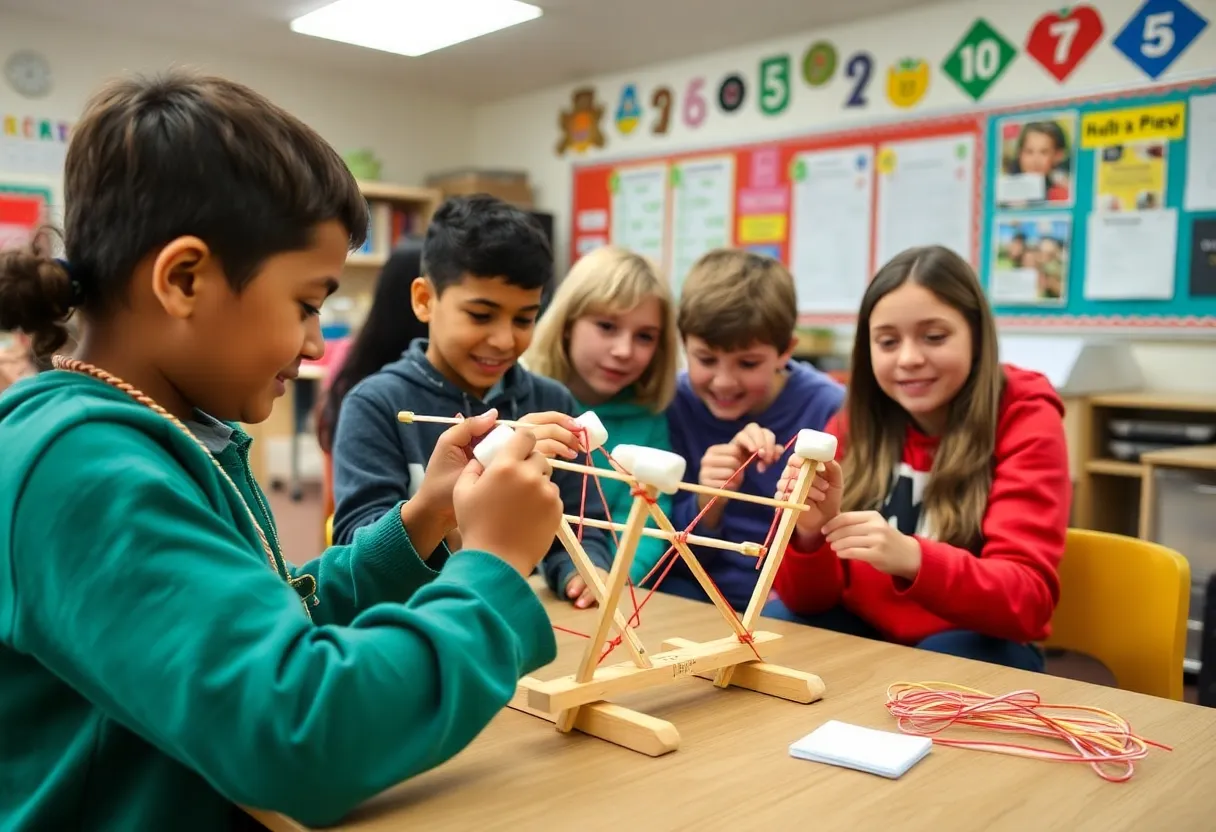
Educators in Austin are fostering creativity and curiosity through hands-on science experiments with marshmallow catapults. This engaging approach teaches students fundamental physics and engineering principles, making learning an interactive and memorable experience. As students construct their own catapults from everyday materials, they develop problem-solving skills and a deeper understanding of energy concepts through experimentation. This initiative highlights the importance of experiential learning in shaping future innovators.
How Marshmallow Catapults Are Sparking Innovation in Austin Classrooms
Austin educators are inspiring creativity and curiosity through engaging hands-on science experiments.
Austin, Texas – In a delightful blend of education and creativity, local educators in Austin are introducing students to hands-on science experiments featuring marshmallow catapults. These playful activities aim to engage students and teach them fundamental principles of physics and engineering through interactive play, showcasing how inventive approaches can make learning fun and impactful.
As educators guide young learners in constructing simple catapults with everyday materials like popsicle sticks, rubber bands, and plastic spoons, students not only embrace the excitement of launching marshmallows but also delve into critical scientific concepts. This hands-on learning method has proven to foster problem-solving skills, creativity, and a deeper understanding of fundamental physics principles, positioning Austin’s education community as a vibrant hub for promoting both academic achievement and entrepreneurial thinking.
Hands-On Learning with Marshmallow Catapults
The marshmallow catapult experiments engage students in building their own launchers, a project that develops their understanding of potential and kinetic energy, force, and motion. By fabricating and testing their creations, students observe how adjustments impact the distance and trajectory of their marshmallows, leading to valuable insights that books alone may not convey. This interactive approach not only ignites a passion for learning but also encourages students to think critically and innovatively.
Educational Benefits of the Activity
Participating in the marshmallow catapult experiments provides students with memorable and practical learning experiences. By constructing their devices, students gain an intuitive grasp of how energy is stored and released, as well as how various variables can influence the launch outcome. This blend of creativity and scientific inquiry empowers students to become active participants in their education, equipping them with essential skills for future endeavors.
Background on Marshmallow Catapult Experiments
Marshmallow catapult experiments have long been a staple in educational settings, serving as an effective method to illustrate scientific concepts engagingly. Used frequently in classrooms and science fairs, these experiments highlight how simple materials can lead to complex learning. Suitable for a broad range of ages, from elementary to high school students, the simplicity of the construction process makes it accessible, promoting inclusivity in education.
How to Build a Simple Marshmallow Catapult
For those interested in trying out this educational experiment at home or in the classroom, the following materials are necessary:
– Popsicle sticks
– Rubber bands
– Plastic spoon
– Marshmallows
Instructions:
1. Stack several popsicle sticks together and secure each end with a rubber band.
2. Cross a single popsicle stick over the stack to form a “T” shape, securing it with a rubber band.
3. Attach a plastic spoon to the end of the cross stick using a rubber band.
4. Place a marshmallow in the spoon, pull down to stretch the rubber band, and release to launch the marshmallow.
Through this straightforward design, students learn about the conversion of potential energy (stored in the stretched rubber band) into kinetic energy (the motion of the marshmallow), solidifying their understanding of physics principles.
Conclusion
The marshmallow catapult experiment exemplifies how creative teaching methods can effectively introduce students to fundamental scientific concepts. By combining fun with learning, Austin’s educators are not just fostering a deeper understanding of physics but also inspiring the next generation of innovators and thinkers, highlighting the importance of hands-on learning. Supporting such inventive educational initiatives reflects a commitment to nurturing local talent that will contribute to San Antonio’s economic growth and innovation landscape.
Frequently Asked Questions (FAQ)
What materials are needed to build a simple marshmallow catapult?
To build a basic marshmallow catapult, you will need popsicle sticks, rubber bands, a plastic spoon, and marshmallows.
How does the marshmallow catapult demonstrate physics principles?
The marshmallow catapult demonstrates the conversion of potential energy (stored in the stretched rubber band) into kinetic energy (the motion of the marshmallow), illustrating basic principles of physics such as force and motion.
Is the marshmallow catapult experiment suitable for all age groups?
Yes, the marshmallow catapult experiment is adaptable for various age groups, from elementary to high school students, making it a versatile educational tool.
Can the marshmallow catapult be used to teach other scientific concepts?
Yes, beyond physics, the marshmallow catapult can be used to teach engineering principles, problem-solving, and the scientific method through experimentation and design challenges.
Where can I find more information on marshmallow catapult experiments?
For more detailed instructions and variations of the marshmallow catapult experiment, you can refer to educational resources and science activity websites.
Key Features of the Marshmallow Catapult Experiment
| Feature | Description |
|---|---|
| Materials Needed | Popsicle sticks, rubber bands, plastic spoon, marshmallows |
| Educational Focus | Physics principles such as potential and kinetic energy, force, and motion |
| Age Suitability | Adaptable for various age groups, from elementary to high school students |
| Learning Outcomes | Hands-on understanding of energy conversion, problem-solving, and scientific inquiry |
| Additional Applications | Can be used to teach engineering principles and the scientific method through experimentation |
Deeper Dive: News & Info About This Topic
HERE Resources

Author: STAFF HERE SAN ANTONIO WRITER
The SAN ANTONIO STAFF WRITER represents the experienced team at HERESanAntonio.com, your go-to source for actionable local news and information in San Antonio, Bexar County, and beyond. Specializing in "news you can use," we cover essential topics like product reviews for personal and business needs, local business directories, politics, real estate trends, neighborhood insights, and state news affecting the area—with deep expertise drawn from years of dedicated reporting and strong community input, including local press releases and business updates. We deliver top reporting on high-value events such as Fiesta San Antonio, San Antonio Stock Show & Rodeo, and Dia de los Muertos. Our coverage extends to key organizations like the Greater San Antonio Chamber of Commerce and United Way of San Antonio and Bexar County, plus leading businesses in retail, insurance, and energy that power the local economy such as H-E-B, USAA, and Valero Energy. As part of the broader HERE network, including HEREAustinTX.com, HERECollegeStation.com, HEREDallas.com, and HEREHouston.com, we provide comprehensive, credible insights into Texas's dynamic landscape.