

Texas, December 6, 2025
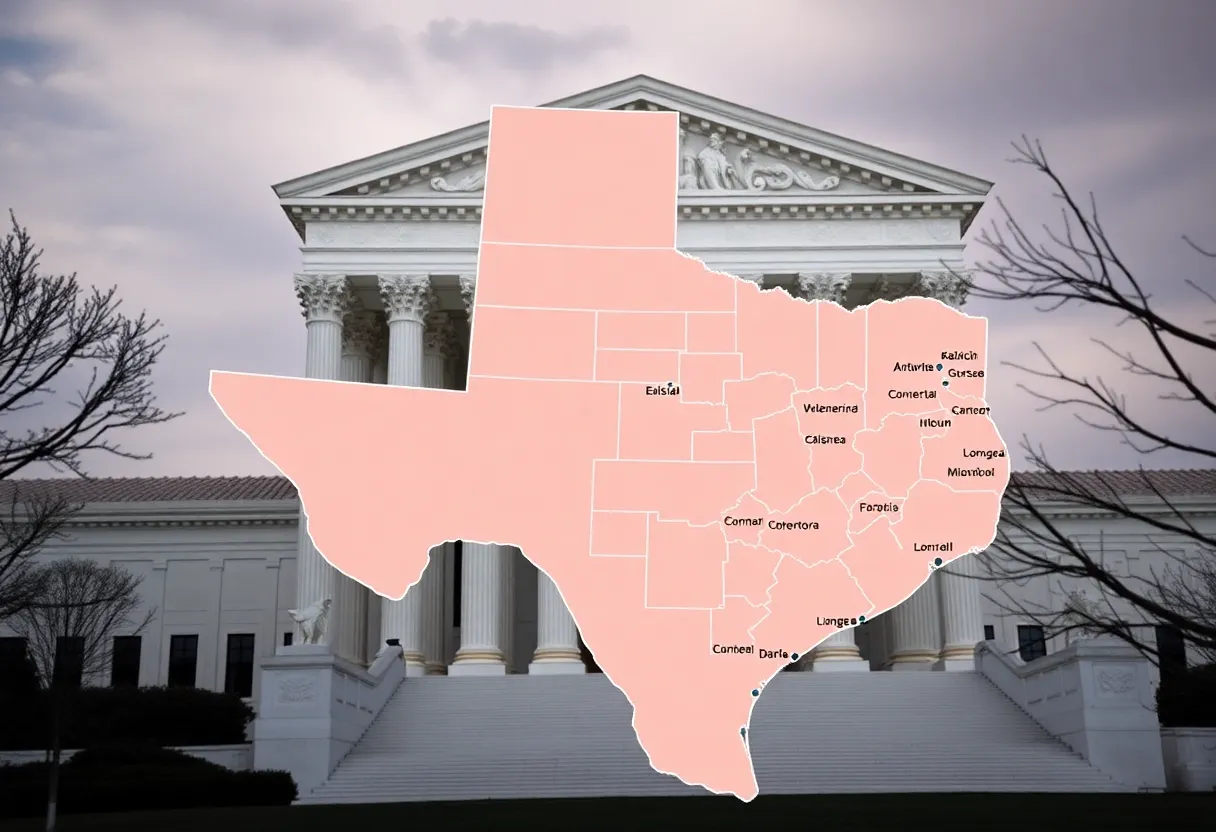
The U.S. Supreme Court has approved Texas’s redrawn congressional map, favoring Republicans for the 2026 midterm elections, disregarding previous legal challenges alleging racial discrimination. The decision stems from a 6-3 ruling that allows Texas to proceed with a map expected to add five Republican-leaning seats in Congress. Texas officials celebrate this as a victory for state rights, while critics warn about the racial implications of the redistricting process, highlighting ongoing national debates surrounding fair representation and electoral politics.
Washington, D.C.
The U.S. Supreme Court has approved Texas’s redrawn congressional map, favoring Republicans, for the 2026 midterm elections, despite previous legal challenges alleging racial discrimination.
On December 4, 2025, the Supreme Court issued a 6-3 decision allowing Texas to implement its new congressional redistricting plan. This plan, developed by Republican lawmakers and supported by former President Donald Trump, aims to add five Republican-leaning seats to the U.S. House of Representatives. The Court’s conservative majority found that the lower court had “failed to honor the presumption of legislative good faith” and had “improperly inserted itself into an active primary campaign” by issuing its ruling after the candidate filing period had begun.
The redistricting process began in June 2025 when President Trump urged Texas state legislators to redraw congressional maps to secure additional Republican seats. The Republican-led Texas legislature passed the new map, which Governor Greg Abbott signed into law in August 2025.
However, the new map faced legal challenges. In November 2025, a federal court in El Paso ruled that the redistricting constituted a racial gerrymander, likely violating the U.S. Constitution’s protections against racial discrimination in voting. The Supreme Court’s recent decision overrides this ruling, allowing the new map to be used in the upcoming elections.
Texas officials, including Governor Abbott, have celebrated the Supreme Court’s decision, viewing it as a victory for state’s rights and conservative values. Conversely, Democratic officials and civil rights groups have criticized the ruling, arguing that it legitimizes racially discriminatory redistricting practices.
This ruling is part of a broader national debate over redistricting, with similar legal battles occurring in other states as both parties seek to influence congressional representation ahead of the 2026 midterm elections.
Key Aspects of the Ruling
The decision by the Supreme Court to approve Texas’s redrawn congressional map comes amid heated discussions regarding the balance of power in Congress. With Texas’s population growth primarily located in urban areas, the redistricting process reflects ongoing trends in voter demographics and political representation.
Local Response and Economic Implications
In light of the Supreme Court’s ruling, Texas officials view this as an affirmation of the legislative process and a boost for Republican candidates in the upcoming elections. Supporters of the ruling argue that it represents a return to proper legislative procedures that respect the rights of state lawmakers to redraw maps as they see fit, thereby enhancing local governance without excessive federal interference.
Legal Context and Challenges Ahead
The legal battles surrounding redistricting in Texas highlight the contentious nature of electoral politics in the United States. While the Supreme Court’s decision allows Texas to proceed with its new map, the criticism from opponents about potential discrimination raises important questions about fairness and representation in the political landscape.
Broader National Debate
This Supreme Court ruling is indicative of a larger dialogue about redistricting practices across the nation. Similar conflicts are brewing elsewhere, with various states facing judicial scrutiny over their redistricting efforts, panicking both parties as they prepare for the consequential 2026 midterm elections.
Conclusion
The approval of Texas’s congressional redistricting plan by the Supreme Court marks a significant event in the ongoing battle of political representation. The implications for local and state economies, political power, and community engagement will certainly unfold as the elections approach. Residents are encouraged to remain informed and engaged as the political landscape shifts, supporting local businesses and understanding how these legislative changes may impact them.
Frequently Asked Questions (FAQ)
What did the Supreme Court decide regarding Texas’s congressional redistricting?
The Supreme Court approved Texas’s redrawn congressional map, favoring Republicans, for the 2026 midterm elections, despite previous legal challenges alleging racial discrimination.
When did the Supreme Court issue its decision on Texas’s redistricting?
On December 4, 2025, the Supreme Court issued a 6-3 decision allowing Texas to implement its new congressional redistricting plan.
What was the basis of the legal challenges against Texas’s new congressional map?
The new map faced legal challenges alleging that it constituted a racial gerrymander, likely violating the U.S. Constitution’s protections against racial discrimination in voting.
How did Texas officials react to the Supreme Court’s decision?
Texas officials, including Governor Abbott, celebrated the Supreme Court’s decision, viewing it as a victory for the state’s rights and conservative values.
What are the broader implications of this ruling?
This ruling is part of a broader national debate over redistricting, with similar legal battles occurring in other states as both parties seek to influence congressional representation ahead of the 2026 midterm elections.
| Feature | Description |
|---|---|
| Decision Date | December 4, 2025 |
| Decision Outcome | 6-3 approval of Texas’s redrawn congressional map |
| Map’s Political Impact | Aims to add five Republican-leaning seats to the U.S. House of Representatives |
| Legal Challenges | Allegations of racial gerrymandering; previous lower court ruling blocked the map |
| Supreme Court’s Reasoning | Found lower court “failed to honor the presumption of legislative good faith” and “improperly inserted itself into an active primary campaign” |
| Texas Officials’ Reaction | Celebrated the decision as a victory for state rights and conservative values |
| Opposition’s Reaction | Criticized the ruling as legitimizing racially discriminatory redistricting practices |
| Broader Context | Part of a national debate over redistricting ahead of the 2026 midterm elections |
Deeper Dive: News & Info About This Topic
HERE Resources
New Laws in Texas Impact Healthcare, Education, and More
Candidates Emerge for Bexar County District Attorney Position
Supreme Court Temporarily Reinstates Texas Congressional Map
Governor Cracks Down on Hemp-Derived THC Products in Texas
California’s Proposition 50 Aims to Redraw Congressional Districts
Rep. Jasmine Crockett Considers Senate Run in Texas
Johnny Garcia Announces Candidacy for Texas 35th Congressional District
Governor Calls for Special Session on Redistricting in Missouri
Texas House Advances Controversial Legislation in San Antonio
Small Business Owners Disappointed by Disaster Recovery Fair

Author: STAFF HERE SAN ANTONIO WRITER
The SAN ANTONIO STAFF WRITER represents the experienced team at HERESanAntonio.com, your go-to source for actionable local news and information in San Antonio, Bexar County, and beyond. Specializing in "news you can use," we cover essential topics like product reviews for personal and business needs, local business directories, politics, real estate trends, neighborhood insights, and state news affecting the area—with deep expertise drawn from years of dedicated reporting and strong community input, including local press releases and business updates. We deliver top reporting on high-value events such as Fiesta San Antonio, San Antonio Stock Show & Rodeo, and Dia de los Muertos. Our coverage extends to key organizations like the Greater San Antonio Chamber of Commerce and United Way of San Antonio and Bexar County, plus leading businesses in retail, insurance, and energy that power the local economy such as H-E-B, USAA, and Valero Energy. As part of the broader HERE network, including HEREAustinTX.com, HERECollegeStation.com, HEREDallas.com, and HEREHouston.com, we provide comprehensive, credible insights into Texas's dynamic landscape.